
Book
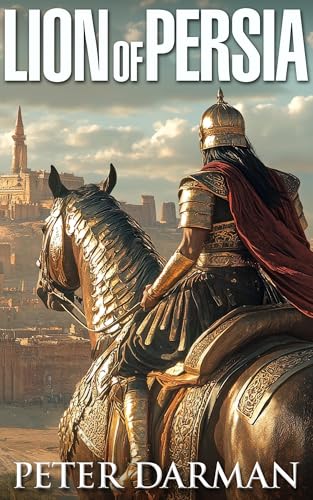
Lion of Persia
First published 2026
Set in Persia in the mid-sixth century BCE, during Cyrus the Great's revolt against Median supremacy and the creation of a new empire, before the Romans. Before the Parthians. Before Alexander the Great. There were the Persians.
In the fertile land of ancient Persia a rising leader, Cyrus, challenges the power of the mighty Median Empire to forge a new world from the ashes of the old. Among the countless warriors who gather beneath the banner of Cyrus, one name would rise from obscurity to become both feared and revered across Persia and beyond: Kian Mihran.
The son of a slave born into a noble household, the brutal murder of his betrothed at the hands of wandering Sarmatians burns away the man he had been. What remains is a warrior driven by grief, hardened by vengeance and sharpened by ordeal. As Cyrus forges his army to elevate Persia above all others, Kian becomes the sword of his king, a leader who has an instinct for war, a ruthless courage and a loyalty that never wavers.
Set amid the sweeping rise of the Persian Empire in the sixth century BC, this epic tale of war, love and sorcery brings to life a forgotten world where history and myth collide, and where one man’s quest for revenge will change the fate of kings and empires.
Cyrus the Great's rise in the mid-sixth century BCE overturned the balance of power in western Asia. Persia first broke Median supremacy and then expanded toward Anatolia and Mesopotamia, combining conquest with the incorporation of existing elites. Kian's advancement from marginal birth to trusted warrior mirrors a political world in which Cyrus was creating new hierarchies and binding diverse peoples to a rapidly expanding monarchy.
Kian's rise is told from close to the ground, through the discipline of armies and the risks faced by men whose status depends on royal favour. Court politics and religious belief widen the story beyond the battlefield, but the central transformation remains the emergence of Persia as the dominant power of the ancient Near East.
The scale of conquest is balanced by Kian's dependence on personal relationships. Promotion brings access to commanders and rulers, but it also exposes him to court rivalries, religious authority and enemies who can attack through reputation as readily as through weapons. His advancement therefore shows both the opportunities created by Cyrus's new order and the insecurity of anyone whose status rests on continued usefulness to a king.
Historical Periods
Historical people

More by the author
Other books by Peter Darman








Discover more
Authors similar to Peter Darman
Recommended from shared genres and periods.
 Christian Cameron
41 books
Christian Cameron
41 books
 Colin Falconer
22 books
Colin Falconer
22 books
 Richard Foreman
43 books
Richard Foreman
43 books