
Historical person
Black Hawk
1767–1838
Black Hawk, or Ma-ka-tai-me-she-kia-kiak, was a Sauk war leader whose resistance to American expansion made him one of the best-known Indigenous figures of the early nineteenth-century Midwest. Born around 1767, he was not the hereditary civil chief of the Sauk but gained influence through warfare and leadership. He opposed an 1804 treaty by which United States officials claimed vast Sauk and Meskwaki lands, arguing that the signatories had lacked authority to surrender the people’s homeland at Saukenuk near the Rock River.
In 1832 Black Hawk led a group of Sauk, Meskwaki and Kickapoo families back across the Mississippi, hoping to resettle or obtain support. Illinois militia and United States troops interpreted the movement as a threat, beginning the Black Hawk War. Pursuit, hunger and fighting culminated in the slaughter at Bad Axe as the band tried to cross the Mississippi. Captured soon afterwards, Black Hawk was taken on a government tour of eastern cities before returning west. His dictated autobiography helped make his account of dispossession and resistance widely known.
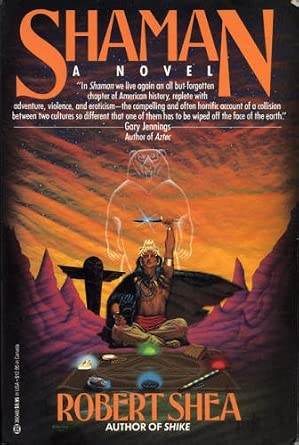
Robert Shea’s Shaman carries its fictional Sauk protagonist into the historical dispossession of Saukenuk and the Black Hawk War of 1832. Black Hawk leads the British Band as families attempt to return east of the Mississippi and are pursued through Illinois and Wisconsin by militia and regular troops. Although the novel remains centred on Sauk households rather than Black Hawk alone, his resistance provides the political and military framework for its final movement toward hunger, flight and the violence at Bad Axe.
Standalone books
Standalone books featuring Black Hawk (1 book)