
Book
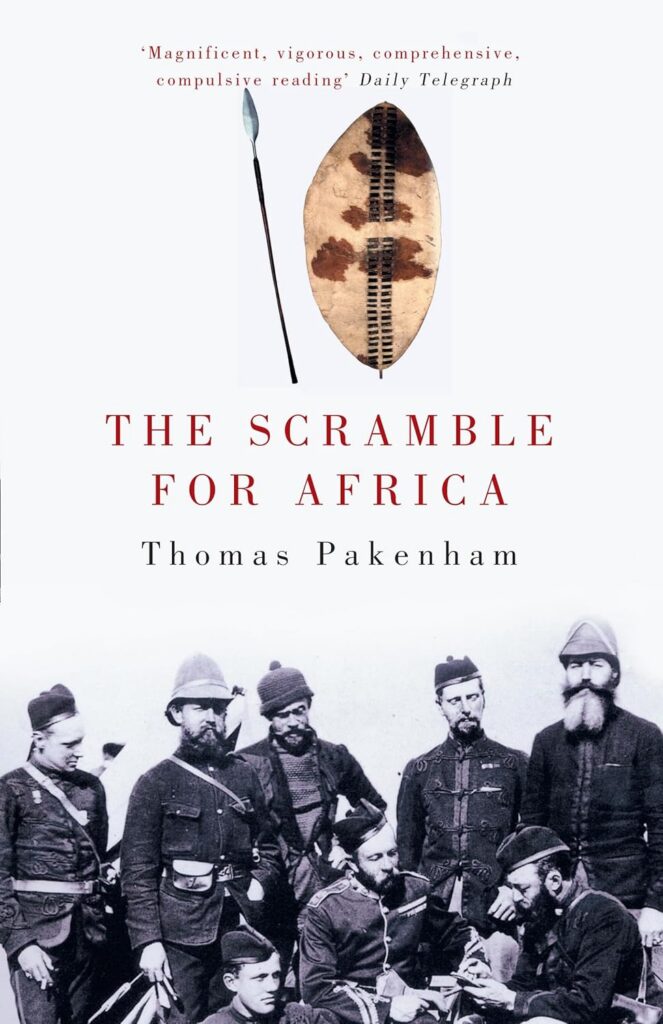
The Scramble for Africa: The White Man’s Conquest of the Dark Continent from 1876 to 1912
Buy the book from:
Thomas Pakenham follows the rapid transformation of Africa from a continent governed overwhelmingly by African states into one partitioned among European empires. Beginning in the 1870s, he connects exploration, missionary activity, commercial schemes and strategic rivalry to the decisions of politicians in London, Paris, Berlin, Brussels, Rome and Lisbon. Henry Morton Stanley’s work for Leopold II, Pierre Savorgnan de Brazza’s French treaties and Otto von Bismarck’s Berlin Conference illustrate how claims made on paper were converted into colonies, protectorates and concessionary states.
The book moves across the Congo basin, the Nile valley, West Africa, Ethiopia and southern Africa to show that partition required diplomacy, deception and repeated military conquest. African rulers and commanders—including Menelik II, Samori Ture and Lobengula—negotiated, resisted or adapted under extreme pressure, while the Mahdist state and the Fashoda confrontation reveal the intersection of African politics with European rivalry. Pakenham treats the Scramble as a connected continental process whose violence, arbitrary borders and administrative systems shaped the colonial twentieth century.