
Historical person
Jean-François Foucquet
1665–1741
Jean-François Foucquet was a French Jesuit missionary, sinologist and later bishop. Born in Vézelay in 1665, he entered the Society of Jesus in Paris in 1681, completed his training for the priesthood and was ordained in 1693. After volunteering for missionary service, he travelled to China and arrived at Xiamen in 1699. He established missions in Fujian and Jiangxi before being summoned to Beijing in 1711 to assist Joachim Bouvet with the study of the I Ching . At the imperial court, Foucquet also discussed astronomy, mathematics and Chinese chronology.
Foucquet collected Chinese books and studied Chinese religion, philosophy and historical traditions, particularly the possibility that ancient Chinese texts contained ideas compatible with Christianity. His interpretations drew him into disputes within the Catholic mission over the Chinese rites and the proper understanding of Confucian and Daoist thought. Recalled from China in 1720, he returned to Europe and eventually settled in Rome, where he was consecrated bishop in 1725. His writings, collections and correspondence contributed to the development of European scholarship on China.
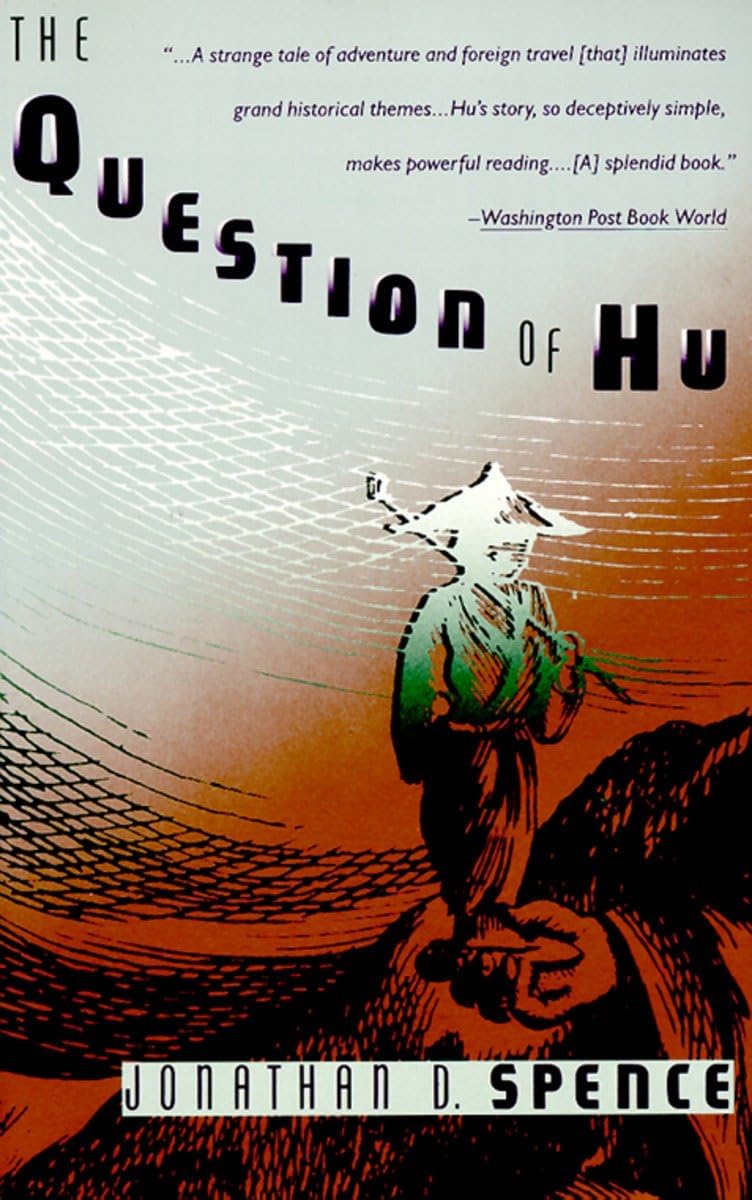
Jonathan D. Spence’s The Question of Hu presents Jean-François Foucquet through his troubled relationship with Hu Ruowang, the Chinese Catholic he brought from Canton to France to assist with his books and scholarship. Foucquet’s expectations of service, religion and discipline repeatedly collide with Hu’s understanding of their arrangement. Their dispute, culminating in Hu’s confinement, makes the Jesuit’s scholarly ambitions part of a larger study of power and cultural misunderstanding rather than simply a story of European learning about China.
Non Fiction
Non Fiction featuring Jean-François Foucquet (1 book)
Biographies, histories and other non-fiction are listed separately from the historical novels above.